Reading the Ground: The Dead Drops & Double Agents Field Dossier
Details
About This Series
This opening chapter begins the private read-ahead series for our Dead Drops & Double Agents travelers: Reading the Ground — The Dead Drops & Double Agents Field Dossier.
The purpose of the series is not to turn the trip into homework. It is to give you a sharper way to see the places we will visit.
Berlin, Leipzig, Prague, and Vienna are often treated as separate destinations. In this series, we will treat them as connected intelligence terrain. Each city reveals something different: the pressure of a divided frontier, the machinery of surveillance, the cost of resistance, the ambiguity of neutrality, and the human choices that shaped events beneath the surface of official history.
Chapter One explains why these four cities belong together, and why I selected them for my company's debut experience. The chapters that follow will move city by city, story by story, through the people, places, operations, institutions, and moral questions that give this tour its deeper structure.
Some chapters will tie directly to sites on the itinerary. Others will provide broader context, so that when we stand at a bridge, enter a former ministry, walk through a public square, or sit in a café, you are not just seeing the location. You are reading the ground beneath it.
You do not need to master the history before we go. But if you follow this series, you will arrive with better questions, better context, and a stronger sense of why these cities still matter.
I hope you enjoy them.
Jack
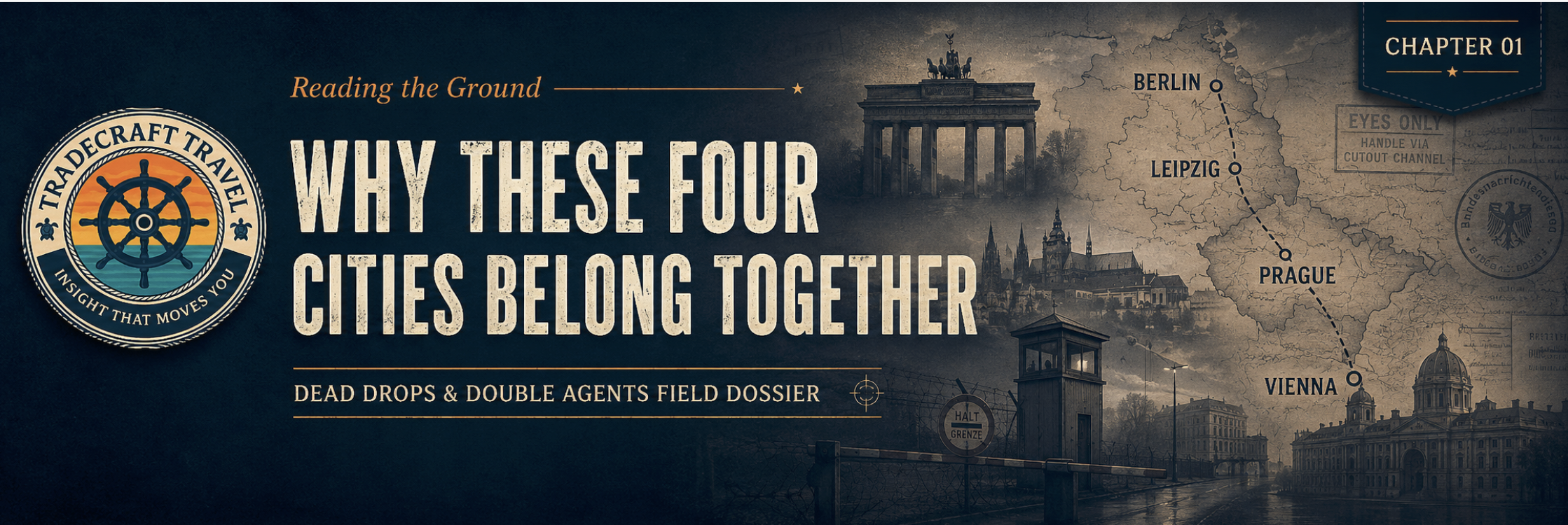
Reading the Ground: Why These Four Cities Belong Together
A Dead Drops & Double Agents Field Dossier
Most travelers move through Europe by landmark. They remember the famous gate, the old square, the museum, the café, the palace, the bridge. There is nothing wrong with that. Landmarks matter because they give history a shape.
But intelligence history asks you to look at a city differently.
A bridge is not only a bridge. It may be a controlled crossing, a surveillance problem, a negotiation venue, or the last place a prisoner sees before stepping from one system into another. A hotel is not only a hotel. It can be a listening post, a meeting site, a place where diplomats, journalists, businessmen, couriers, and intelligence officers all move through the same lobby with different purposes. A train station is not just a transit point. It can become a border, a pressure chamber, a place of farewell, a place of fear. A café is not only a café. It can be where political ideas, exile networks, gossip, diplomacy, and espionage quietly overlap.
That is the premise of this field dossier.
The Dead Drops & Double Agents tour is not built around four cities simply because they are attractive, historic, and close enough to connect in a single journey. I chose Berlin, Leipzig, Prague, and Vienna because each teaches a different lesson about intelligence, power, ideology, and human choice. The official itinerary describes the route as an immersive journey through Cold War capitals, moving from Berlin’s spy sites and Stasi history to Prague’s surveillance legacy and Vienna’s role as a neutral intelligence hub. That is the visible structure of the trip. The deeper structure is the intelligence thread that ties these places together.
Berlin is the front line.
No city in Europe made the Cold War more physically visible. After 1945, Berlin was divided among the victorious powers, and over time that division hardened into concrete, checkpoints, guard towers, procedures, and doctrine. The Berlin Wall Memorial exists today to document the city’s division and remember those who died because of it; its preserved border elements at Bernauer Straße are a reminder that the Wall was not a metaphor. It was a system built to control movement, divide families, and preserve a political order by force.
That made Berlin a natural intelligence battlefield. The Western Allies were not merely present in Berlin; they were operating inside an exposed enclave surrounded by East Germany. The Allied Museum documents the role of the United States, United Kingdom, and France in Berlin from 1945 to 1994, including the political and military commitments that made West Berlin both a symbol and a vulnerability. For intelligence services, that environment created opportunity and risk in equal measure. Access was valuable. Proximity was valuable. So were tunnels, listening posts, liaison relationships, defectors, interrogations, and the daily observation of an adversary’s behavior at close range.
Berlin gives us the hard edge of the Cold War: military presence, divided sectors, controlled crossings, technical collection, and the constant possibility that a local confrontation could become a global crisis.
Leipzig is different.
Leipzig was not the front line in the same way Berlin was. It was not a divided city surrounded by geopolitical theater. Its importance lies inside the system. It shows us how a state watches its own people, and what happens when the watched begin to act together.
That is why Leipzig matters so much. The former Stasi district headquarters at the Runde Ecke is not dramatic in the cinematic sense. It is an office building. That is precisely the point. A surveillance state does not run only on ideology or fear. It runs on files, phones, forms, reports, informants, career ambition, petty grievances, institutional habits, and the ordinary mechanics of bureaucracy. Recent coverage of the Runde Ecke notes that the museum’s long-running exhibition, “Stasi – Macht und Banalität” — “Stasi: Power and Banality” — has been shown in the former Stasi district administration building since 1990. Even the title captures the unsettling truth: repression can be both monstrous and administrative.
Leipzig also gives us the other side of the equation: civil courage. The Monday demonstrations that began in Leipzig in 1989 became central to the peaceful revolution that helped bring down the German Democratic Republic. That matters for an intelligence traveler because surveillance is not the same as control. A regime may know who attends a prayer service, who speaks to whom, who distributes leaflets, who has relatives in the West, and who has been overheard saying the wrong thing. It may still fail to understand when fear is losing its power.
That is one of the recurring lessons of this dossier. Collection is not comprehension. A file is not legitimacy. A crowd is not just a crowd; it is a signal. And by the time the signal is unmistakable, the regime may already be in trouble.
Prague is layered memory.
If Berlin teaches us about confrontation and Leipzig teaches us about internal pressure, Prague teaches us about the long shadow of occupation, resistance, betrayal, and survival. Prague’s intelligence history does not begin in 1948 with the communist takeover or in 1968 with Soviet tanks. It runs through Nazi occupation, exile politics, British-supported resistance, the assassination of Reinhard Heydrich, wartime reprisals, postwar communist consolidation, surveillance, dissidence, and the eventual collapse of one-party rule.
That layering is why Prague has to be treated carefully. It is one of Europe’s most beautiful cities, but beauty can distract from what happened there. The same streets that now carry visitors toward Old Town Square, Charles Bridge, cafés, churches, and museums also carried people living under occupation, people reporting to underground networks, people being watched, people choosing silence, and people deciding whether resistance was worth the cost.
Operation Anthropoid is the most direct example. It is easy to tell it as a story of bravery and successful assassination. It was that, but not only that. Intelligence operations are never sealed off from the world around them. They create consequences. The destruction of Lidice in June 1942 came as part of the Nazi reprisal campaign after Heydrich’s assassination; the village became a symbol of Nazi terror because civilians paid the price for a war of occupation, resistance, and retaliation.
That does not mean resistance was wrong. It means history deserves more than slogans. Operations have purpose, costs, and second-order effects. States act. Networks act. Individuals act. Then families, villages, and future generations live with the result.
Prague forces us to hold more than one truth at a time: the necessity of resistance, the brutality of occupation, the courage of individuals, the danger of betrayal, and the terrible vulnerability of civilians caught between power and principle.
Vienna is the shadow capital.
At first glance, Vienna seems less obvious than Berlin. It was not divided by a wall after the Cold War settled into its familiar pattern. It became associated with neutrality, diplomacy, music, cafés, and imperial elegance. But neutrality did not make Vienna irrelevant to intelligence. It made Vienna useful.
A neutral city can be a meeting ground. It can host diplomats from opposed systems, international organizations, journalists, businessmen, émigrés, refugees, couriers, and officers operating under different forms of cover. It can create precisely the kind of ambiguous environment in which intelligence services work: formal politeness on the surface, quiet competition underneath.
Vienna also reminds us that intelligence history did not begin with the CIA, KGB, Stasi, or StB. Imperial capitals had their own systems of information, influence, censorship, military reporting, diplomatic maneuver, and informant networks. The Habsburg world understood that power depended not only on armies and palaces, but on knowing what rivals, subjects, officers, diplomats, and revolutionaries were doing.
Then came the twentieth century: war, collapse, occupation, black markets, displaced people, Allied zones, and the atmosphere captured so effectively in The Third Man. The Third Man Museum in Vienna preserves material related to the film and the historical setting of postwar occupied Vienna, when the city’s ruins, divided authorities, and underground spaces gave moral ambiguity a physical form.
Vienna teaches a quieter lesson than Berlin, but not a lesser one. Intelligence often lives in the spaces between official categories: diplomacy and spying, journalism and access, neutrality and alignment, conversation and recruitment, hospitality and surveillance.
Across all four cities, one principle will guide these chapters: systems collect, but people decide.
Technical collection matters. We will talk about listening posts, surveillance tools, bunkers, tunnels, border infrastructure, and the geography of concealment. Teufelsberg matters because signals intelligence mattered. The Berlin Tunnel matters because engineering and access mattered. Hotel rooms, cafés, embassies, stations, sewers, and checkpoints mattered because intelligence work is always shaped by terrain.
But human stories will remain at the center.
People recruit and are recruited. People betray and are betrayed. People inform because they believe, because they fear, because they are pressured, because they want money, because they want status, because they want revenge, or because they have convinced themselves it is the safest available choice. People resist for equally human reasons: duty, faith, patriotism, anger, conscience, loyalty, or because a line has finally been crossed. People inside intelligence services make judgments with incomplete information. Sometimes they get it right. Sometimes they do not. Sometimes they behave honorably. Sometimes they exceed their mandate, rationalize misconduct, or mistake operational success for moral clarity.
This dossier will not pretend that all systems were morally equivalent. Open societies, even flawed ones, operate with legal constraints, public accountability, elections, courts, legislatures, and a free press. Authoritarian systems use intelligence and security services differently, particularly when they turn them inward to control speech, movement, association, and memory. That distinction matters.
But honest intelligence history also requires humility. Collection, surveillance, deception, liaison, recruitment, and covert action are tools. The moral question is not whether one side used tools and the other did not. They all used tools. The question is purpose, constraint, accountability, and consequence. Who was being protected? Who was being controlled? Who could challenge the system? Who could not? Who paid the price when an operation succeeded, failed, or was exposed?
That is why we will read the ground.
When we stand at a bridge, we will ask what made that bridge useful. When we pass a former ministry, we will ask how an institution converted suspicion into procedure. When we enter a museum, we will ask what the exhibits reveal and what they leave unsaid. When we walk through a square, we will ask how public space becomes political space. When we sit in a café, we will ask why informal conversation has always mattered to formal power.
By the time we move from Berlin to Leipzig, from Leipzig to Prague, and from Prague to Vienna, the goal is not simply to know more facts. Facts matter, but they are not enough. The goal is to develop a way of seeing.
These cities are not frozen Cold War stage sets. They are living places with restaurants, hotels, commuters, students, tourists, and ordinary routines. That is part of what makes them powerful. Intelligence history rarely happened in places marked “historic intelligence site” at the time. It happened in offices, apartments, churches, rail stations, embassies, hotel lobbies, cafés, bridges, tunnels, and streets people used every day.
That is the thread connecting the tour.
Berlin shows the confrontation.
Leipzig shows the pressure inside the system.
Prague shows the cost of occupation and resistance.
Vienna shows the ambiguity of neutral ground.
Together, they teach the central lesson of intelligence travel: history is not only in the archive. It is in the terrain. The work is learning how to read it.
© 2026 Tradecraft Travel LLC. All rights reserved. This material is provided exclusively for registered Dead Drops & Double Agents travelers and may not be copied, distributed, or republished without written permission from Tradecraft Travel LLC.